|
|
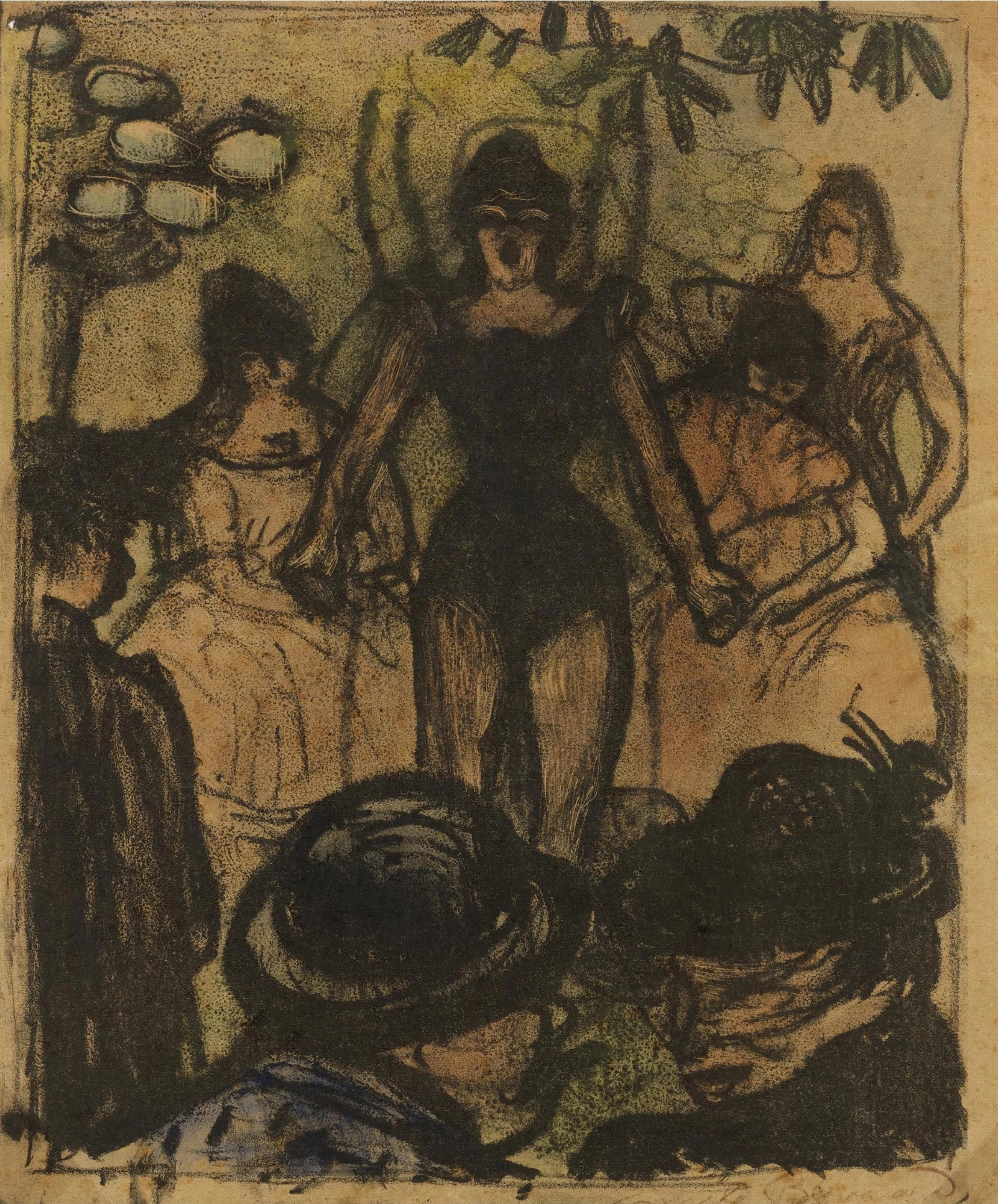
La Chanteuse du
Café-Concert
(The Songstress in the Cabaret)
Morane 5
zincograph, 1888, a splendid working proof of the rare first state (of two), printed in
black on medium-fine
tan
wove paper, extensive heightened with watercolor wash, signed
in brown crayon lower right,, with small though uneven margins, some
slight overall soiling, a well-repaired horizontal tear from the center
right into the image, another short tear on the lower left edge, small
paper losses along the margins, several pinholes, foxing on the verso,
mounted in stiff matting board with transparent corners, otherwise in
relatively good
condition
Provenance: Swann
Auction Galleries, New York City, 18 September 2008, lot 13; and
Sotheby's, New York City, 30 April 2009, lot 23
P. 298 x 232 mm.
S. 326 x 250 mm.

|
The year of 1888 was
crucial in the development of these new art forms in France* and Emile
Bernard was drawn to printmaking at the same time. Recourse to
zinc plates as a remplacement for lithographic printing was in practice
since the 1820's, and Pissarro was notably an exponent, but the
synthetist movement gave it renewed vigor. (Incidentally,
according to Marcel Guérin**, it was Bernard's idea "to obtain
these grained washes that may be seen both on his plates and Gauguin's,
by taking a brush and diluting the ink with water on the zinc plate."
La Chanteuse du Café-Concert
is the second of Bernard's zincographs, and the present impression is
clearly a working proof of the utmost rarity... we have only seen one
other first-state impression in black on auction in recent years (the
Jeffry Kaplow Collection, Drouot, 4 November 2020), and an equivalent
impression may be seen in the INHA, Doucet Collection in Paris (see
http://bibliotheque-numerique.inha.fr/idurl/1/15851), which has been
trimmed down close to the borderline. We know of only one other
first-state impression that has been heightened with watercolor: see
the Tajan sale, 4 December 2006, of similar dimensions.
Emile Bernard's intention to
produce a colored version is also witnessed by a curious impression in
the INHA, Doucet collection, which both the INHA and Caroline
Boyle-Turner qualify as a "second state", with fine pastel heightening,
filling a diffuse background of ochre-yellow and purplish-violet across
the songstress's bodice.***
The colored version was never
taken to completion, and never realised as an edition... we only know
of several later impressions that he produced during his stay in
Egypt , several years later.
In any case, the present
impression is of the utmost rarity, and is of significant art historical interest.
* See the cogent discussion of these developments in the WPI document by Fred Leeman here:
http://archive.org/details/c.remilebernardwildensteininstitute/page/n55/mode/1uphttp://archive.org/details/c.remilebernardwildensteininstitute/page/n55/mode/1up
** Marcel Guérin, L'Œuvre gravé de Gauguin, Paris, H.Floury, 1927, p. xi.
*** Caroline Boyle-Turner, Gauguin & l'Ecole de Pont-Aven BNF, Paris, 1989.