 Emile
Bernard
Emile
Bernard
Emile
Bernard
Emile
Bernard
Best known as one of the founding figures of the Pont Aven school in Brittany, Emile Bernard (1868
- 1941) however first developed his novel approach to art in Paris,
where he crossed paths with both Toulouse-Lautrec and Van Gogh.
He
elaborated cloisonnism
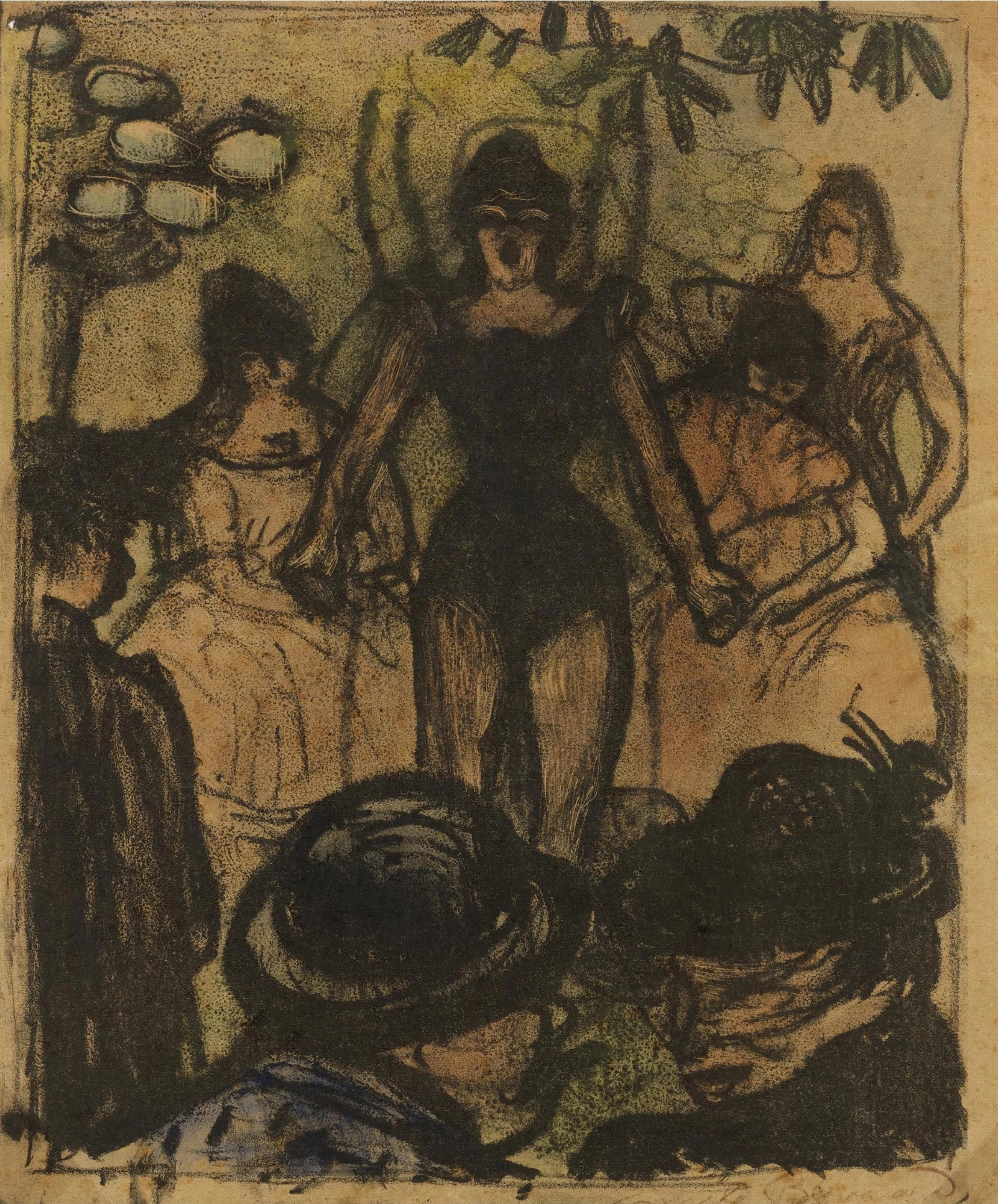
as a radical pictural style with Louis Anquetin, inspired by Cézanne,* which fed most naturally into his graphic work of
the time, as may be seen in what is one of his earliest prints, here
below.
He first met
Gauguin at Pont Aven in 1888 and they worked together to create what
would become the revolutionary movement of sythetism.
They exhibited conjointly at the Café
des Arts,
chez Volpini, the following year, which would become a major art historical event. Their relationship was
troublesome (though it inspired some of Bernard's most poignant work), and
they broke in 1891, after only three years, ... his series of
color prints, Bretonneries, stand as a monument in 19th-century French printmaking.
__________________
* Cf. Emile Bernard's writings on Cézanne: https://gallica.bnf.fr/ark:/12148/bpt6k6572642c.texteImage#Ň
|
La
Chanteuse du Café-Concert
[The Songstress in the Cabaret] |
  |