
Edouard
Manet

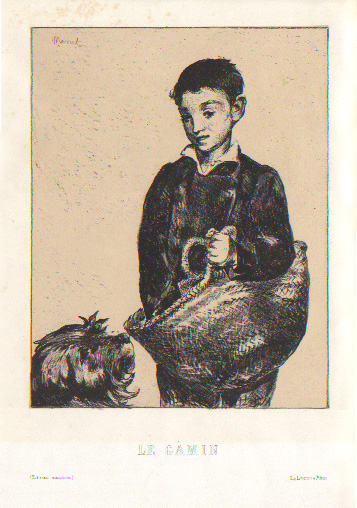
Manet, Le Gamin, lithograph

Le Gamin

Moreau-Nélaton 86, Guérin 71, Harris 30, Fisher 62, Wilson-Bareau 75

lithograph, 1868-1874 (see below), on fine pale greyish-violet-toned Chine collé paper, applied to heavy white vellum, the 2nd state (of 2), with the lithographed title ("LE GAMIN") below, the print run ("Tiré à cent exemplaires") lower left, and the name of the printer (Imp. Lemercier & Cie, Paris) lower right, a fine impression with full margins, as published in the first (and only edition) in 1874, slight uniform light-staining around the image from the window opening in an old mount, and very faint localised foxing above the image to the left, a superficial scuff in the upper right margin of the vellum, a short tear (12 mm.) in the vellum from an old mount lower left, slight soiling on the reverse, traces of hinges from an old mount on the reverse edge, otherwise in very good condition

P. 287x227 mm., S. 537x454 mm.

Provenance: a private Parisian collection

A later (and quite faithful) lithographic version of Manet's 1861 oil painting (see Janot, Wildenstein, and Bataille, Manet, 1932, n° 73) , which he also etched in 1862 (cf. Guérin 27), Le Gamin is thus one of Manet's favorite and most touching subjects: it furthermore allowed him to demonstrate his versatility in using a fine point and scraper to highlight and model the boy's features, and graphically render textures and tonal values. 

Given this hiatus of 12 years, the lithograph has proved hard to date, especially as it is known that (aside from two sheet music covers, published in 1863 and 1866) Manet's first "real" lithographs, Le Rendez-Vous des Chats and L'Execution de Maximilien) were undertaken in 1868.  Published at the same time as Le Gamin in 1874, La Guerre Civile is dated 1871-1873.  The question is still open.

Le Gamin is however a rather rare lithograph, if one may only judge by the small number of impressions seen on auction in recent years.  Fisher (1985, 105) notes that although this lithograph and La Guerre Civile (published at the same time in 1874) were nominally "printed in an edition of one hundred, ... their rarity suggests a smaller edition."  It was indeed commonplace in the 19th century to print at first only a fraction of the print run that had been announced, with a complementary run following if the work sold well.